It was a crucial force in the abolitionist movement. It’s still standing today This material is copyright The Guardian.
Located in Ontario, the church provided shelter and aid to Black Americans who participated in the Underground Railroad to escape slavery in the US
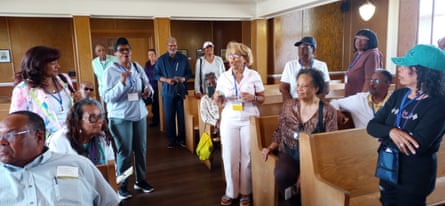
Rochelle Bush guides touristd into Salem Chapel, the British Methodist Episcopal church in St Catharines, Ontario, Canada.
Bush is the brand Tubman Tours Canada. She is the historian at Salem Chapel’s built centuries ago.
The church’s roots stretch to about 1788 when Black people, many of whom were seeking freedom from slavery in the US, began to settle in the St Catharines area.
Along with their hopes, dreams and plans for the future, these settlers, many of whom were followers of John Wesley, the founder of Methodism, and Richard Allen, a founder of the African Methodist Episcopal church, brought their religions with them.
Bush, like many parishioners of Salem Chapel today, is a descendant of those people, whom she calls “freedom seekers”. Through her tours, she seeks to keep the memory of the Black Americans who sought freedom in Ontario, and the lives they built on arriving there, alive.
‘They knew that in the eyes of God, we’re all the same’
Salem Chapel is one of the oldest Black churches in Ontario. Though it may not be widely known to most Americans or Canadians, its influence on both countries’ history is undeniable. The church, which is still in use as a religious institution, is considered a sacred site and tourist destination because of its importance for people who participated in the Underground Railroad and for their descendants.
After the passage of the 1850 Fugitive Slave Act, which required that people who escaped slavery be returned to the people who enslaved them even if they had made it to a state in which slavery was illegal, the Black community in Ontario rapidly increased with the arrival of thousands of fleeing Black Americans.
The expanding community outgrew the church they were using to worship, and the congregation decided to build a larger church to serve the growing population. On 4 November 1855, the new African Methodist Episcopal church, “dedicated to the service of Almighty God”, by Daniel Alexander Payne, an American bishop, was opened.
Secrets of Success: the church that served a plantation remains a monument of resistanceRead more
The church’s pulpit is the original – the same one that Harriet Tubman, who lived in St Catharines for about a decade, Frederick Douglass and John Brown would have sat before as parishioners or would have spoken behind as lecturers. Display cases contain original wrought iron rails, and the pews upstairs date back to the 1800s – the lower-level pews are from the 1950s. There are other time-specific items, such as an original offering plate, a first edition copy of Harriet Beecher Stowe’s Uncle Tom’s Cabin, a union jack flag from around the 1880s and a first edition copy of the biography of Jefferson Davis, the Confederate president.
St Catharines was known by prominent abolitionists, including Douglass, who wrote that the Underground Railroad had many branches, but that the one with which he was connected started in Baltimore and ended at St Catharines.